
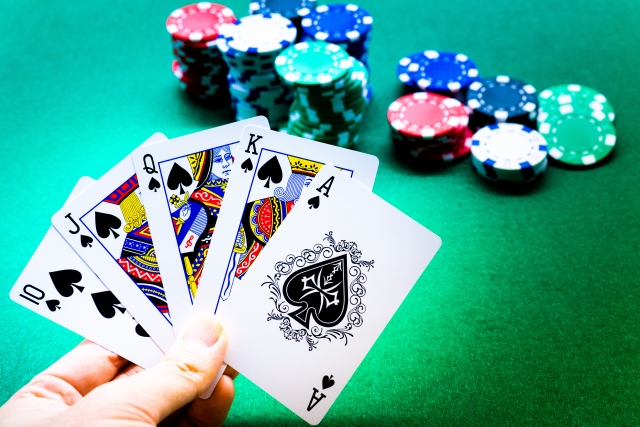
Since playing cards are inextricably linked to gambling, I believe it’s essential to properly study and confront information about gambling offenses, which is why I wrote this article. “Gambling” refers to staking money on a game where the outcome determines the transfer of ownership of assets, primarily money.
The brain’s reward system is designed to crave gambling.
Gambling purely generates thrills and powerful rewards, and those who become addicted to it are endless. This isn’t about weak willpower or anything like that; it’s the brain’s reward system that causes it, as shown in the following research report from Japan’s University of Tsukuba.
As a result, people succumb to their instincts and end up throwing money they can’t afford into a massive black box where winning or losing is uncertain. It’s perfectly understandable that this must be prevented in order to build a healthy society.
I myself often recognize this tendency within me. Whether it’s the intense competition in the rating systems of online mahjong apps like Mahjong Soul or Board Game Arena, even if these activities don’t technically break the law, I personally feel that the act itself stimulates primal instincts. When experiencing that gambling-like thrill, a recent Japanese expression describes it as “brain juice overflow” (脳汁が出る, No-Jiru).
I am against gambling.
The reasons are as follows.
- I don’t see the rationality in money moving in a game where you don’t know if you’ll win or lose (I believe money should move when you feel it’s “appreciated”).
- I wonder if players joining this game to make money genuinely think the system is fun!! and participate wholeheartedly?
- I’m simply scared of assets moving based on game results (if someone taunts me with “Scared?” I’d definitely be scared, so I’d say no).
- Just calling it a gambling game limits the user base.
There might be other reasons too, but… I want to understand human instincts and play the game so I don’t lose.
Japanese law
So how did Japanese law come to be defined, and what provisions are defined?
Article
First, I will confirm the laws regulating gambling in Japan, where I live. Japan has three definitions established as legal provisions.
| 罪名 | 条文 | 内容 |
|---|---|---|
| 賭博罪(単純賭博) | 第185条 | Any person who gambles shall be punished by a fine not exceeding 500,000 yen or a minor fine. However, this shall not apply to “temporary entertainment items.” |
| 常習賭博罪 | 第186条1項 | Persons who habitually engage in gambling shall be punished by imprisonment for not more than three years. |
| 賭博場開張等図利罪 | 第186条2項 | Anyone who operates a gambling establishment or organizes gamblers for profit shall be punished by imprisonment for not less than three months nor more than five years. |
刑法|条文|法令リード ⇢You can view it by searching for “賭博”.
“Temporary entertainment items” refer to low-value goods that are consumed like juice and do not constitute assets.
Enactment Background and Context
The reason why this regulation exists is not explicitly stated in the Criminal Code, but there is a precedent case. It seems more accurate to say that the law came first and was then interpreted.
裁判例結果詳細 | 裁判所 – Courts in Japan
単なる偶然の事情に因り財物の獲得を僥倖せんと
相争うがごときは、国民をして怠惰浪費の弊風を生ぜしめ、健康で文化的な社会の
基礎を成す勤労の美風(憲法二七条一項参照)を害するばかりでなく、甚だしきは
暴行、脅迫、殺傷、強窃盗その他の副次的犯罪を誘発し又は国民経済の機能に重大
な障害を与える恐れすらあるのである。
https://www.courts.go.jp/app/files/hanrei_jp/521/054521_hanrei.pdf
This rationale is often cited as the basis for enacting gambling laws. My summary and understanding are as follows:
- Gambling for money instills the notion that one can obtain compensation without labor, permeating society with this common sense.
- It makes the act of working seem pointless, adversely affecting economic functions.
- It incites secondary crimes such as assault, intimidation, homicide, robbery, and other violent offenses.
I’m satisfied with this, but is it a document that might invite objections from some people? Recently, there’s been a push to establish casinos in Japan, but for now, gambling is illegal in Japan, so let’s avoid it.
By the way, in the Yu-Gi-Oh! card game originating in Japan, there was a mysterious rule at launch where players fought by betting cards called “Ante Rules.” However… since cards are assets traded for thousands to tens of thousands of yen, not consumables like juice, you’d definitely get arrested for gambling offenses. 😅